

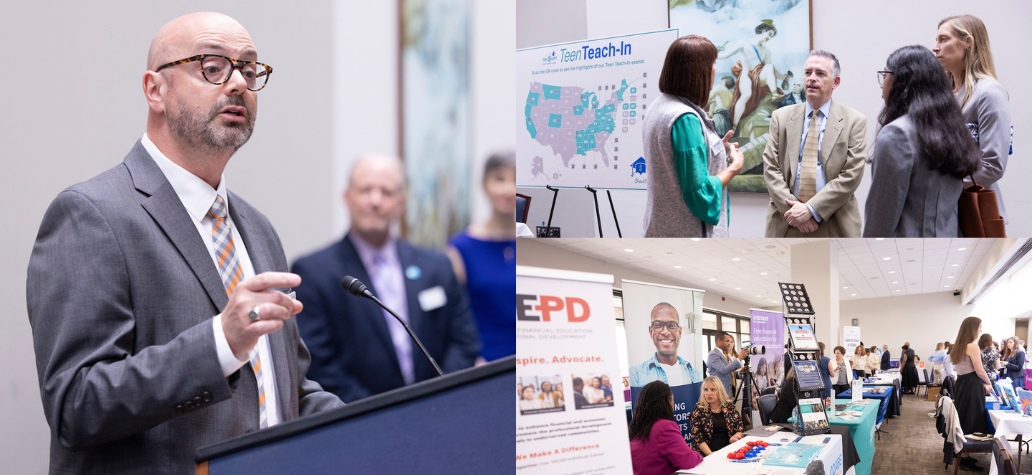
After a successful in-person return in 2023, Financial Literacy Day on Capitol Hill was back and buzzing this June. We were excited to co-organize this event with the founding organization, and our continued partner, the Jump$tart Coalition for Personal Financial Literacy. Back in the beautiful Hart Senate Building, we were grateful to be welcomed by the honorary co-hosts Sen. Jack Reed (D-RI) and Sen. Tim Scott (R-SC), who both highlighted the importance of financial literacy and cross-sector partnerships’ roles in advancing quality financial education.
Joined by advocates, educators, practitioners and policymakers of various backgrounds and specializations, the 2024 Hill Day exhibited the commitment and alignment of a diverse group of stakeholders invested in financial education. Together, these partners-in-mission celebrated progress and discussed future collaboration, all in the name of elevating financial well-being and equipping individuals with the necessary tools and insight to live their best financial lives.
"Financial Literacy Day on Capitol Hill is a wonderful opportunity to witness the financial education field in action, sharing a collaborative energy working toward the common goal of helping people live their best financial lives. School-based financial education is experiencing tremendous momentum, but it must be inclusive and implemented thoughtfully. This is a 21st century life skill and a cornerstone for our financial health.”
Billy Hensley, Ph.D., president and CEO of NEFE.
Sens. Reed and Scott, co-founders and co-chairs of the Senate Financial Literacy Caucus, shared their unique experiences which inspired them to champion financial literacy—both in their respective states and at the federal level—and thanked the crowd for their tireless work pursuing this same goal.
Sen. Reed, whose home state of Rhode Island passed K-12 financial education graduation requirements in 2021, highlighted the consequential impact of heightening financial literacy, as well as the bipartisan efforts to support this cause that recently culminated in the 20th consecutive Financial Literacy Month Senate Proclamation in April.
“Our [Rhode Island] students understood that they would not be prepared for college [or life after] without a solid foundation in financial literacy.”
Senator Jack Reed, (D-RI)
Sen. Scott’s home state of South Carolina passed K-12 financial education graduation requirements in 2022. He has been a champion of financial education accessibility as ranking member of the Senate Banking Committee, as well as leading federal efforts to provide financial education wherever possible.
“I believe that the greatest future we have as a nation will be in the hands of young people who benefit from your investment in their lives. So to those of you doing that – thank you… You might just be the springboard they needed to get to where they’re going.”
Senator Tim Scott (R-SC)
“Hill Day is one of the best depictions of Jump$tart as a coalition because as you visit each exhibit, you see the unique contributions that each partner makes; but when you step back and take in the room as a whole, you feel the strength of our collective, collaborative commitment.”
Laura Levine, President and CEO of the Jump$tart Coalition
The Senate Hart room was packed with exhibitors who shared their research, curricula, programs and government services that all served the mission of elevating financial education. Attendees had the opportunity to network and collect resources and information to further their efforts. This year’s Financial Literacy Day on Capitol Hill represented a unique opportunity for individuals and organizations working in distinct areas of financial education to come together, celebrate their successes and the substantial recent momentum around financial education, and discuss future partnerships that could further support their work.
In a room full of dedicated professionals committed to their mission, the excitement and eagerness to collaborate was palpable. While our co-hosts represent states with K-12 financial education requirements in place, many of the exhibitors came from states that have not yet adopted such measures, and the forward-pointing discussion focused on how we can continue to elevate financial education and assist people in improving their financial well-being. There are still many young people and adults across the country who have limited access to financial education and resources, and this need highlights why the continued efforts of the Financial Literacy Day on Capitol Hill attendees remain so vital.
Hunter Field is Manager, Policy and Advocacy for the National Endowment for Financial Education (NEFE), a nonprofit foundation that champions effective financial education. NEFE is the independent, centralizing voice providing leadership, research and collaboration to advance financial well-being.