
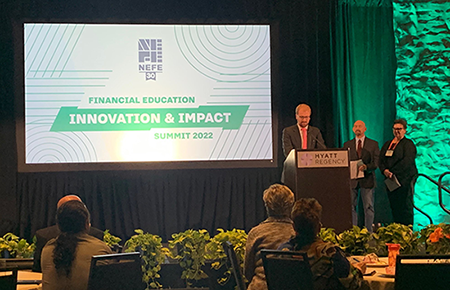
NEFE launched our redesigned strategic partnership initiative in 2022, starting with an announcement at our inaugural Financial Education Innovation & Impact Summit.
The initiative establishes a new research-to-practice laboratory to enable us to champion and advance effective, population-specific practices in financial education and provide guidance and support for the future of the financial education field. We will be making a significant investment in this initiative.
Partnership Projects
 Our first strategic partnerships are in two geographical areas representing different underserved higher education students. We have invested $2.5 million for this collaborative research on financial education programs and services that are tailored to the needs of their unique populations.
The Appalachian College Association focuses on first-generation, rural and lower-income college students in Georgia, Kentucky, North Carolina, Tennessee, Virginia, and West Virginia. The 34 colleges of the Association serve 77,000 students.
The Colorado Community College System encompasses all 13 community colleges across the state. The colleges primarily serve a minority population of working adult who study part-time, reaching 111,000 Coloradans. They were chosen due to their strong histories of providing direct services and programs to their respective communities, their ability to implement a pilot program tailored to the needs of their specific populations and their commitment to financial education access.
Appalachian College Association Final Evaluation Report
Our first research-to-practice laboratory project—an initiative enabling us to champion and advance effective, population-specific practices in financial education—has completed after a two-year pilot. An evaluation of the results, conducted as part of the project closure, highlights significant improvements in important categories by those engaging in the curricula.
We partnered with the Appalachian College Association to examine 13 financial education programs across seven colleges during the 2023-24 and 2024-25 academic years. The programs included credit-bearing courses, online modules, lecture series and coaching experiences tailored to each campus. The research strengthened financial practices at institutions which serve a high percentage of rural and first-generation college students.
ICF, an independent research firm, was engaged to evaluate the interventions using a quasi-experimental design. More than 1,000 students in the treatment group and 225 students in the comparison group completed pre- and post-surveys measuring financial knowledge, skills, behaviors and well-being.
The evaluation found significant positive effects across all major outcome areas. Students in the treatment group demonstrated greater gains in subjective and objective financial knowledge, financial skills, budgeting behaviors, credit monitoring behaviors and overall financial well-being compared with students in the comparison group. Students also reported high satisfaction with their programs. The findings provided strong evidence that locally designed financial education programs targeting rural and first-generation college students improved financial capability and confidence.