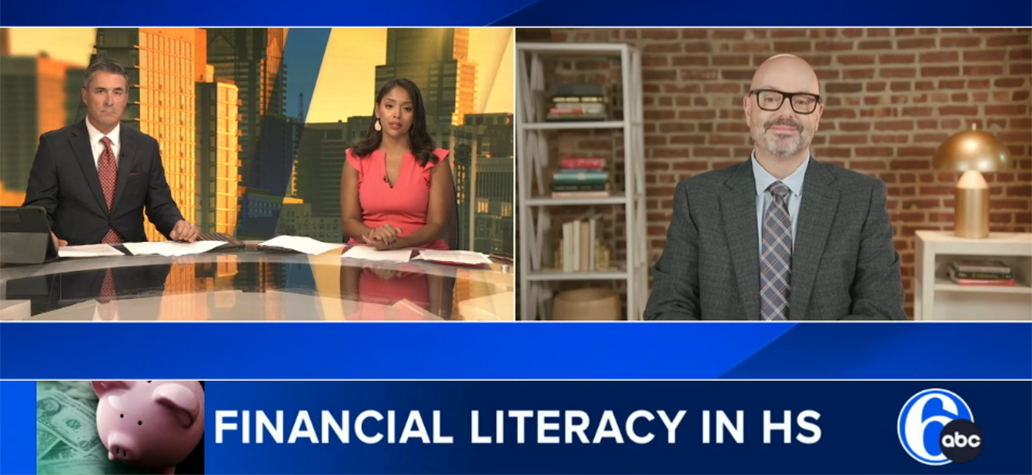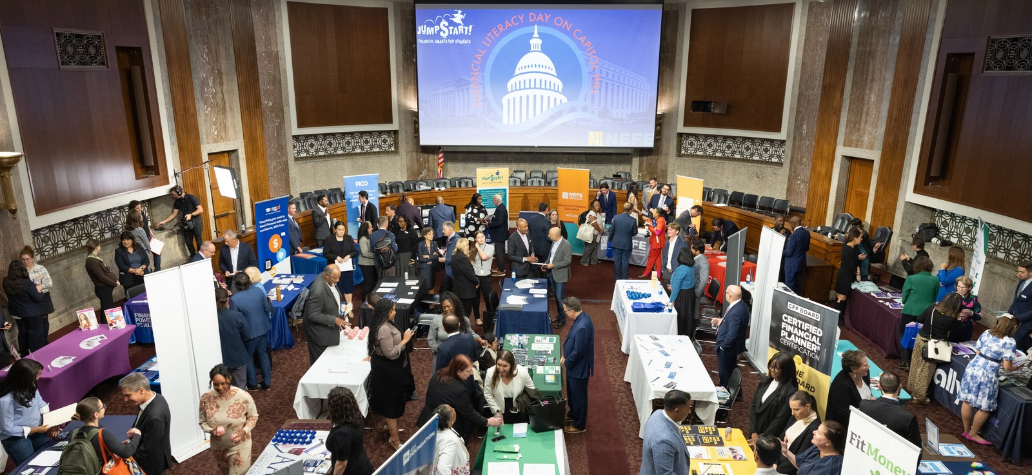

Financial Capability Month (also known as Financial Literacy Month) provides a platform to participate in national conversations about the challenges and possibilities in financial education. This year, Financial Capability Month offers NEFE a unique opportunity to share its perspectives and data with the federal government to help shape the future of the field.
The U.S. Treasury Department, on behalf of the 23 federal agencies that make up the Financial Literacy and Education Commission (FLEC), requested input from interested and informed parties on the U.S. National Strategy for Financial Literacy. Since its founding in 2003, FLEC has served as a national convener of financial education leaders to present and analyze key areas of focus. The purpose of this National Strategy is to ensure the commission's programs and initiatives continue to be relevant, effective and responsive.
NEFE leveraged this moment to provide insight to this request. Since 2020—the last time this strategy was updated—the field's landscape has changed immensely, and as an independent, centralizing voice, NEFE's data and experience are viewed as unbiased in support of the changes under consideration.
Here are excerpts from NEFE's response to FLEC:
How the topic of financial education has evolved:
"[T]he rapid evolution of cryptocurrency, prediction markets and sports betting, new types of scams and fraud (especially those targeting older Americans, servicemembers and veterans), artificial intelligence and other tools and products have made it far more difficult for individuals to understand and navigate financial systems. In this challenging environment, consumers need help finding, understanding and acting upon trustworthy financial information and guidance."
How financial education is viewed nationally:
"Public opinion and policy momentum demonstrate a nationwide agreement about the importance of investing in financial education. Over eight in 10 (83%) U.S. adults say that their state should require a semester-long or year-long course focused on personal finance education for high school graduation, and 82% whose high schools did not offer such a course say they wish they had been required to take one in order to graduate, according to polling conducted by NEFE in March 2025. These results were consistent across party lines, with 84% of Republicans, 83% of Democrats and 85% of independents expressing support for a state-level financial education requirement."
The role the federal government could take:
"First, as noted in the 2020 National Strategy, the federal government supports the broader financial education field 'through policy development, research coordination, and focused program and resource development.' Second, the federal government provides direct financial education to consumers through a host of individual programs, including direct consumer education regarding Trump/530A Accounts, Federal Student Aid borrower education efforts, Housing and Urban Development homebuyer counseling initiatives, Department of Defense programming for new and transitioning servicemembers, and many others captured in the FLEC annual reports to Congress. These programs offer FLEC member agencies an opportunity to test, enhance and role model effective financial education delivery for the broader field."
The importance of measuring and evaluating impact:
"A holistic strategy for providing value to Americans through financial education requires a deep understanding of how individual programs and policies are shaped, influenced and constrained by the broader systems through which they are offered, as well as how to avoid any unintentional harm they might cause. The federal government should also seek ways to improve resources and infrastructure for researchers, practitioners and policymakers to facilitate cross-sector collaboration and address this crucial gap. This includes, but is not limited to, sustained investment in existing federal research efforts, such as those conducted by the CFPB, alongside support for the broader research field."
The weight financial education should carry in a broader solution:
"NEFE believes it is important to emphasize the role of financial education in empowering individuals to successfully understand and make decisions about their financial well-being. NEFE’s Personal Finance Ecosystem (PFE), a framework developed to assist policymakers, researchers and other stakeholders, helps to place financial education in the broader context of individual and systemic factors that influence a person’s financial journey. The PFE demonstrates how a range of variables, including foundational factors such as access to financial services and products, as well as individual experiences and values, work together to determine a person’s definition of, and ability to pursue, financial well-being. Research conducted by NEFE and our partners illustrates the ways the PFE factors can vary across groups and individuals, including indigenous populations, rural communities and Americans who have experienced financial trauma, to name a few. Finally, the PFE highlights the importance of continuous financial education throughout an individual’s life as other factors change."
Nationwide progress for efforts in K-12, postsecondary education and the workforce:
"Studies and polls conducted by the FINRA Foundation, the Federal Reserve, NEFE and many others offer ample evidence that U.S. adults need more support as they manage financial challenges and pursue meaningful economic opportunities. Of particular concern to NEFE are the nearly 43 million federal student loan borrowers holding more than $1.7 trillion in debt, millions of whom are at risk of delinquency and default in the coming years, according to the Congressional Research Service. We hope investments by the federal government continue, in partnership with states and the financial education field, to support and advocate for the financial well-being of U.S. youths and adults alike."
This call to revise the National Strategy comes at a time of heightened attention on financial education. At the time of this response, 30 states require—or are implementing requirements—for financial education instruction in high school, while employers increasingly recognize the value in supporting their employees’ personal financial knowledge.
View NEFE's entire response to this inquiry here.