

August 28 – September 4, 2026
The use of artificial intelligence (AI) is a growing part of how Americans live their lives, yet empirical evidence on how often, and why, they turn to AI to support making financial decisions remains limited. We also know relatively little about how the use of AI for financial advice relates to financial literacy, experience with financial education, and other financial behaviors. To better understand this important issue, the National Endowment for Financial Education (NEFE), in collaboration with SurveyUSA, surveyed 2,079 U.S. adults about their use of, and trust in, artificial intelligence tools for financial advice. Of this sample, 676 respondents (35% weighted) say they have used AI to get information or guidance on a money topic or financial decision. The survey also included questions on financial product ownership, measures of respondents' financial literacy and financial well-being and their experiences with financial education.
Survey responses are weighted to American Community Survey (ACS) targets for age, gender, race, education, U.S. region and homeownership to enable comparisons with the general population of U.S. adults. This survey is an initial attempt to understand how AI is showing up in the financial lives of U.S. households, and what follows summarizes a limited set of early findings.
Key Findings
Artificial intelligence is already a mainstream source of financial information
Among people who use AI tools for any purpose (66%), about half (51%) have used them for financial information or guidance. In the past year, more people turned to an AI chatbot for information about their personal finances than to a financial professional.
The people using AI for financial guidance look different from everyone else. They’re younger, have higher incomes and more education, and are much more likely to report having had financial education (55%, compared with 18% of people who have never used AI). However, it isn't only the well-off. Even after accounting for demographics (age, gender, race, income, education and urbanicity), people who use buy now, pay later or other alternative financial services are more likely to use AI for financial guidance. And as a group, people using AI for financial guidance do not appear to be any more financially literate than other respondents.
Every following comparison between groups controls for age, gender, race, income, education and urbanicity. People who have received financial education, as well as those with different levels of access to financial advice, tend to differ in those characteristics. Controlling for these factors ensures that any reported differences are not simply due to these demographic characteristics.
Receiving financial education is associated with greater AI use and greater trust in AI, but not with greater caution
A primary motivating question of this research was, "How does financial education change the way people use AI in seeking and evaluating financial information?" We approached it with two competing hypotheses: people who have had financial education might be more skeptical of AI and rely on it less, or they might be (or believe they are) better at using it responsibly.
Our initial results lean toward the second hypothesis. The data suggests that recipients of financial education not only use AI more but are also more likely to trust the advice they receive without checking other sources.
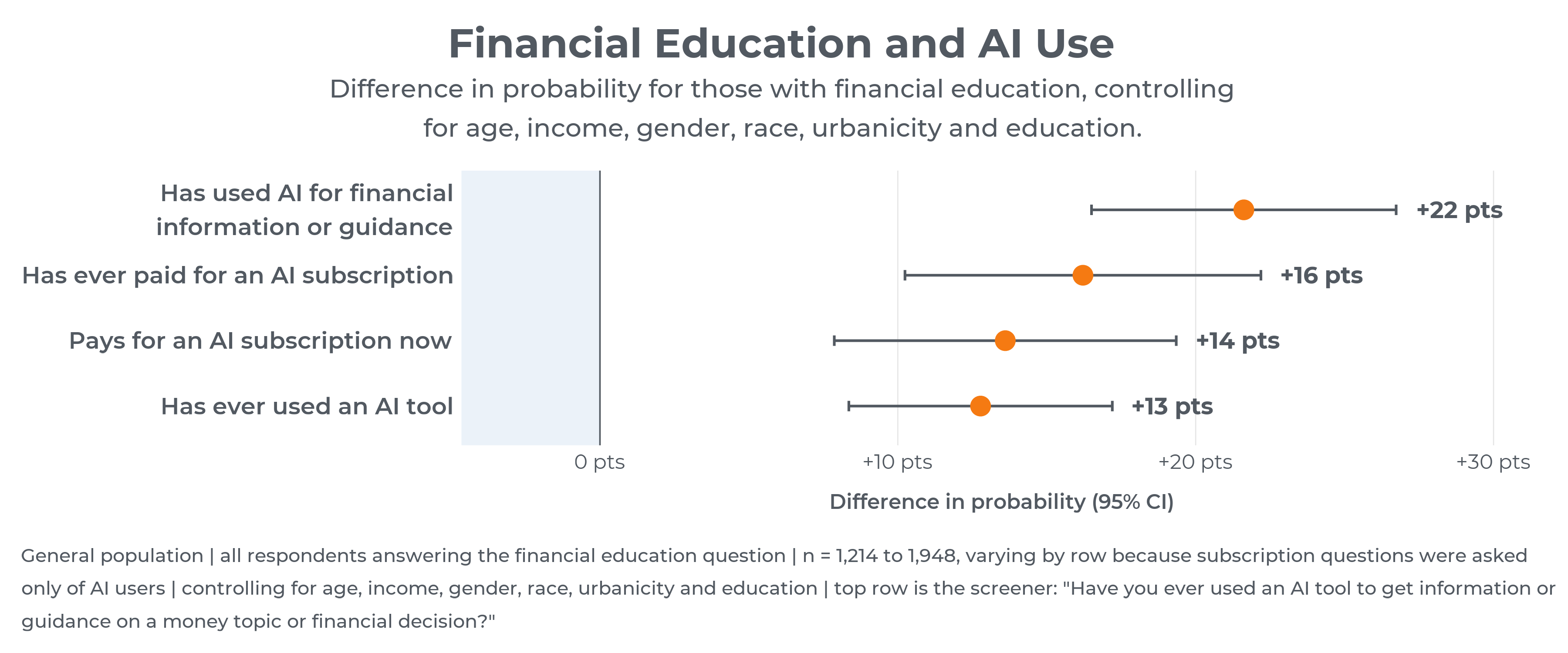
Of adults who have taken a financial education course, 50% have used AI for financial information or guidance. For those who have not received financial education, only 28% report using AI for financial information or guidance. Those who have taken a financial education course are also more likely to have ever used, or paid for, a subscription to an AI tool.
People who have received financial education also use more sources of information across the board. They are 17 percentage points more likely to consult personal finance websites and eight percentage points more likely to seek guidance from banks and financial professionals. They’re also 17 percentage points less likely to report using none of the sources we asked about. AI appears to be one more source in the mix rather than a replacement for others.
TRUST
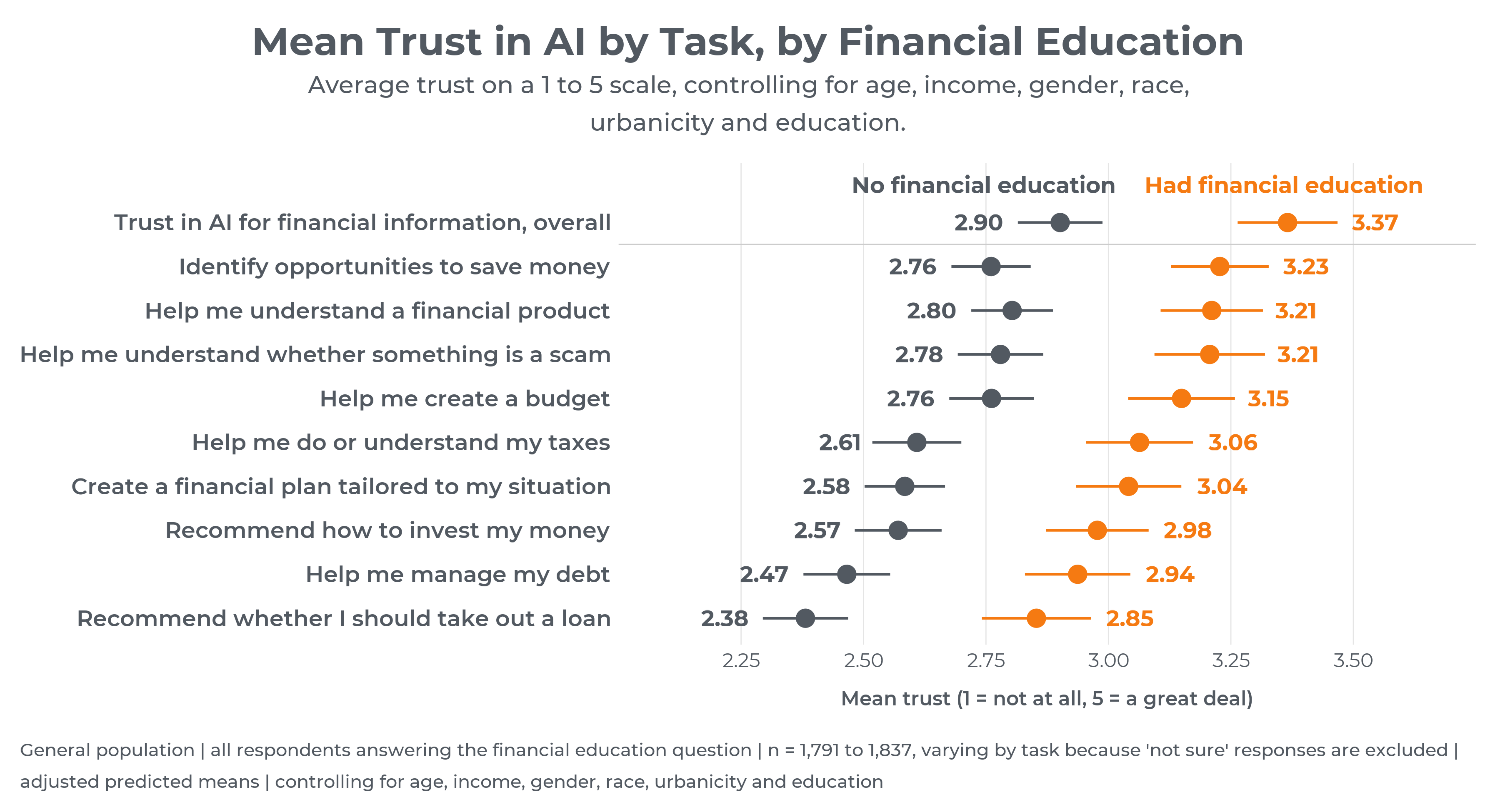
Overall, trust in AI as a reliable source of financial information is moderate. About a third of adults (35%) trust it a great deal or quite a bit, while 29% trust it very little or not at all. When split by financial education, a consistent gap appears. On a one-to-five scale, people with financial education average 3.4 on overall trust in AI for financial information, compared with 2.9 for people without. That gap of roughly half a point holds on every specific financial task we asked about (e.g., creating a budget, understanding a financial product, or recommending how to invest). Trust in AI decreases for both groups as the stakes rise, and recommending whether to take out a loan ranks lowest for both.
ACTING ON ADVICE
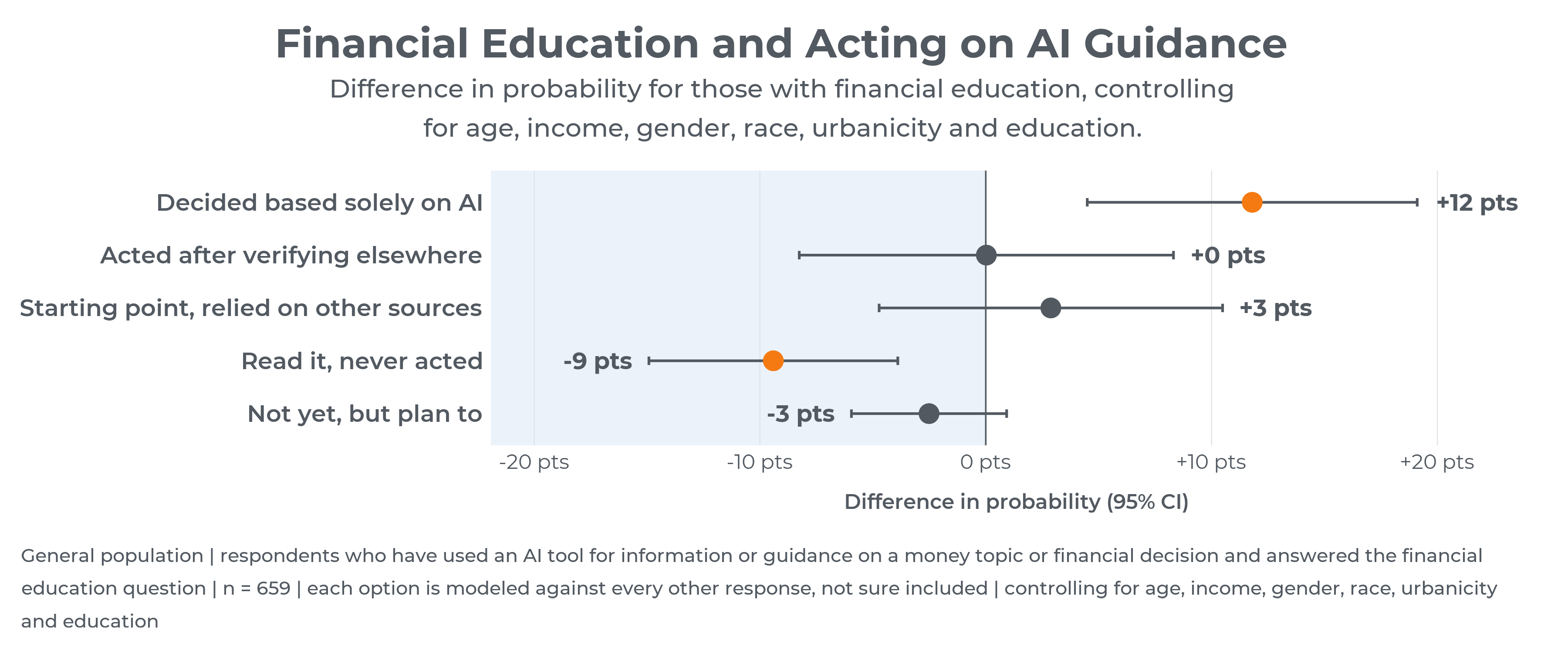
Beyond trust, we wanted to know whether people who have used AI for financial guidance actually act on the information they receive. About a quarter of people who have used AI for financial guidance (26%) made a decision based "solely" on what it told them. Another 30% acted after checking another source first, and 25% used AI as a starting point.
Here, the relationship with financial education is more nuanced. People who received financial education are 12 percentage points more likely to have made a decision based solely on AI, and nine percentage points less likely to have read the guidance and never acted on it. When it comes to checking another source before acting, there appears to be no difference between people with and without financial education.
Verifying information matters because AI does not guarantee accuracy. Worryingly, among people who have used AI for financial guidance, 21% report that they later found the information was incorrect or misleading, and another 26% got information they say didn't apply to their situation. Of those who got incorrect or misleading information, 58% had already acted on it before they found out. Checking more than one source is good practice for anyone, which makes it notable that people with financial education are more likely to act on information from AI alone.
People use AI because it’s accessible, but it is not closing an access gap
People mostly use AI for financial guidance because it's easy to access. Respondents cite using it because it’s free (44%), it's available any time (43%), and about a quarter (27%) like that they can ask "without being judged." We anticipated that AI could help close the gap in access to financial information for those who otherwise could not or do not know how to access a financial professional, but these results suggest otherwise. Controlling for demographics, 53% of those who already work with a financial advisor and 43% of those who say they could access one if they wanted have used AI for financial guidance. In contrast, 33% of those who say an advisor is too expensive and about a quarter of those who don't know how to find one (25%) or feel those services aren't meant for them (24%) have used AI for this purpose. Rather than closing the access gap, AI appears to be most used by people who already have access to professional financial advice.
What this means for financial education
Taken together, people who have had financial education use AI more for financial information, trust it more, and act on the information they receive more. But they’re no more likely to verify what it tells them with other sources. We can’t say from this survey that financial education causes this, but the pattern raises a few possibilities. Verification may be a skill the field is assuming people have rather than one we’re teaching. It’s also possible that financial education leaves people overconfident in their ability to judge the accuracy of financial information.
As more people bring financial questions to AI, including higher-stakes ones like investing, debt and taxes, the role of financial educators, counselors, and planners becomes increasingly important. It is critical to encourage people to check AI’s answers even when they feel confident and to consider whether general guidance actually fits their own situation.
This is only the beginning
We look forward to releasing additional analyses of this rich survey dataset over the coming months, and we welcome comments and ideas that could inform future survey work on this topic. On Oct. 14, 2026, NEFE convened a small working group at our Denver offices. The convening discussed financial education in the age of AI and featured several presentations by researchers and practitioners. NEFE is committed to intentionally creating space to discuss critical topics, like the use of AI, in the field of financial education. We hope our research insights serve as a starting point for future inquiry.
Survey Methodology
The data reported here were collected in partnership with SurveyUSA between Aug. 28 and Sept. 4, 2026. SurveyUSA interviewed 2,079 U.S. adults online using a nonprobability sample of adult online panelists chosen randomly by Cint USA. Where necessary, questions and answer choices are rotated to prevent order bias, recency, and latency effects. You can view Survey USA’s full methodology statement, which conforms to the principles of disclosure recommended by the National Council on Public Polls here.
A Note About Reading the Report and Data Supplement
The percentage of respondents has been included for each item. Percentages may not always add up to 100% because of computer rounding or the acceptance of multiple responses.
Explore more findings and other survey research here.